Journal Paper | "It didn't look the way I had imagined": Students engaging with the past through an immersive virtual reality experience of ancient Greek divination
- 2026 | Chris Bevan, Richard Cole, Esther Eidinow, Kirsten Cater, Crescent Jicol, Michael J. Proulx, Hugh Bowden, Quinton Deeley.
- Computers & Education: X Reality. Elsevier.
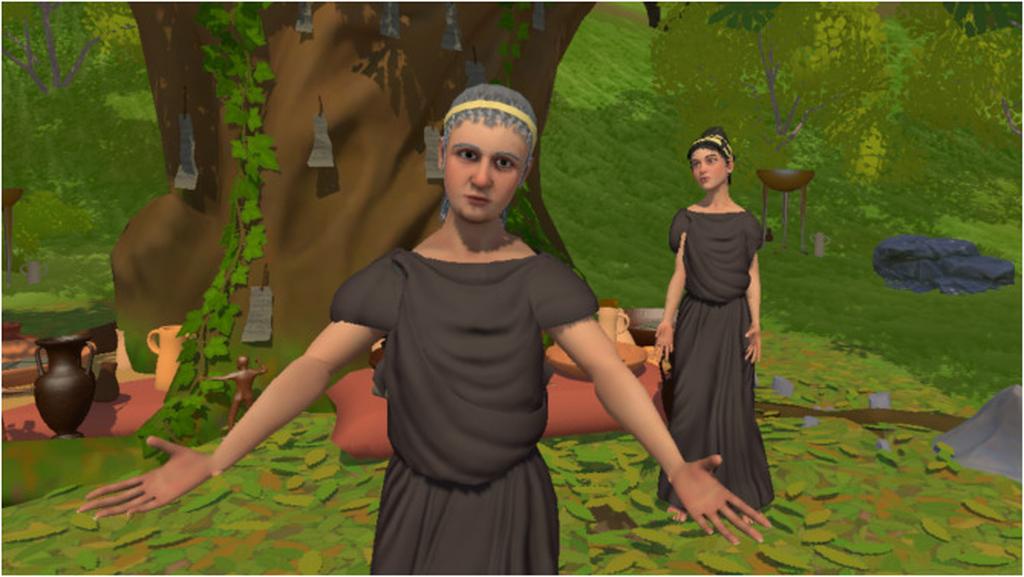
Abstract | Immersive Virtual Reality (IVR) offers new ways to support how students learn about the ancient world. However, most classroom studies of IVR have a STEM disciplinary focus, drawing on learning approaches that may not generalise to the humanities. We conducted an in situ study of a humanities-focused educational IVR experience, delivered within a live classroom to students of an ancient history course. Using a between-subjects design (N = 84), we varied the medium of delivery for key teaching content between teacher-led instruction and an IVR experience. Between-group differences in prior knowledge, motivation, and responsiveness to immersive media were controlled for. Two learning outcomes, Recall Performance and Knowledge Engagement, were assessed using a mix of single and multiple-mark examination questions, administered one week after the lesson and repeated twelve weeks later. We found that participants who encountered the teaching content via IVR showed markedly better knowledge retention at twelve weeks than those taught conventionally. This finding runs contrary to several comparable studies and underscores the need for further investigation of IVR's longitudinal effects on learning. We also found that the medium of delivery shaped how students developed conceptual understanding of the material. Those who learned in IVR found the experience visually compelling, but this also fostered a heightened sense of certainty about the “truth” of what they had seen, and a corresponding reduction in willingness to consider alternative interpretations. Conversely, students taught without IVR demonstrated greater imaginative engagement and less certainty, resulting in a more open consideration of competing ideas. Our results are discussed in terms of the implications of IVR-based learning for humanities students, with particular attention to the care required when designing IVR historical experiences for classroom use.
- Associated Project
- The Virtual Reality Oracle (VRO): An Immersive Experience of the Ancient Greek Oracle at Dodona
- Available at
- https://www.sciencedirect.com/science/article/pii/S2949678026000346
- DOI
- https://doi.org/10.1016/j.cexr.2026.100166